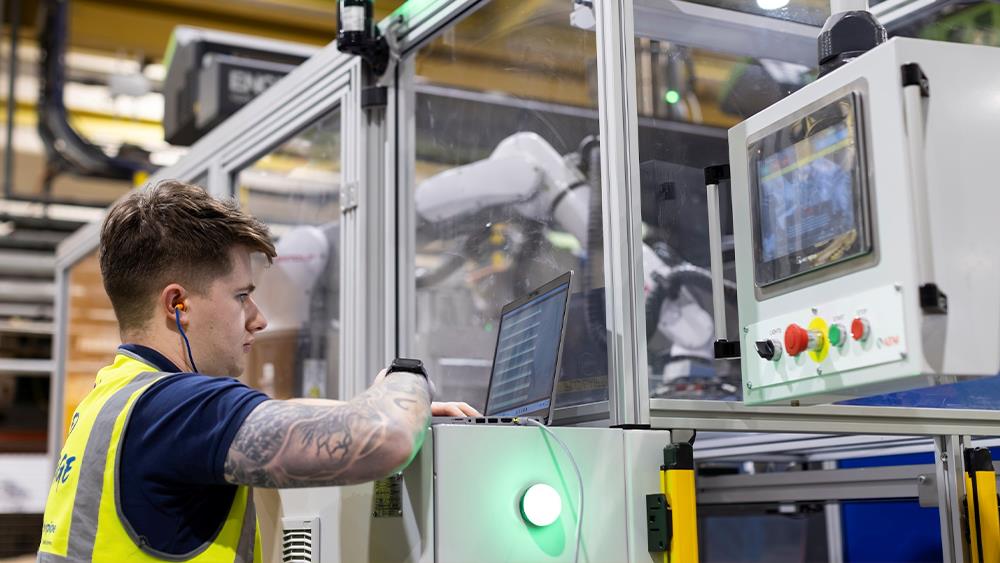
Josh Fuller, Automation Project Manager.


Polypipe Building Services has enhanced manufacturing efficiency, productivity and sustainability through a major programme of automation investment at its production facility in Aylesford.
The manufacturer now uses fully automated lines across key areas of the site, integrating robotics and AI-driven quality inspection systems as part of a long-term strategy to improve operational performance and address industry-wide skilled labour shortages.
With this new level of automation, Polypipe has been able to meet its growth aspirations, without increasing staffing levels and the facility, which operates on a 24-hour, five-day production cycle, has increased output and improved responsiveness to fluctuating demand.
Recent investment includes £1.5 million in automation technology, alongside further investment of £3 million in moulding machinery, and £2.5 million in extrusion technology.
The manufacturer has implemented automated systems using six-axis and Cartesian robots, allowing operators to oversee production processes that deliver finished products with minimal manual intervention. As a result, Polypipe has improved the consistency and quantity of its drainage and water supply products while maintaining existing workforce levels.
Advanced vision technology, including the new IV4 AI camera, has also been introduced to support quality assurance. The system automatically counts parts and detects issues such as dimensional variation, ovality and moulding defects, helping ensure products meet quality standards before being packaged by robotic handling systems.
The introduction of automation has significantly improved labour efficiency across production lines, the company says. Where processes previously required one operator per machine, production can now typically be managed at a ratio of one operator to four machines. This has enabled the business to redeploy employees into higher-value technical and operational roles.
Ned Seale, Tooling and Automation Manager at Polypipe Building Services, said: “Automation is helping us respond to growing demand while maintaining quality and supporting our workforce. By integrating robotics and AI inspection technologies, we are improving production consistency, reducing waste and allowing teams to focus on more technical, value-adding activities.
“While the initial investment can be significant, automated systems can deliver long-term operational benefits through improved efficiency, quality and resource optimisation.”
Automation is part of Polypipe’s overarching strategic move to drive efficiency, productivity and sustainability across its operations. Since the transition, the manufacturer has recorded reductions in energy use and material waste.
Polypipe is continuing to expand its automation capability through workforce development, including the recruitment of an automation apprentice and plans to further grow its engineering team. The next phase of automation investment is expected to focus on the fabrication department, where manual processes are currently used to manufacture prefabricated pipe systems.