West Fraser discusses the ecological challenges facing the construction industry, and how they can be mitigated by the use of carbon negative materials.
In 2012, in its Living Planet Report, the World Wildlife Fund asserted that, if the Western developed nations continued with their pattern of consumption, we would need three planet's worth of resources by 2050. During the intervening years, consumerism and population have expanded across regions like Africa and parts of Asia, with supposedly sustainable activities, such as sourcing the minerals required for electrical vehicles, steadily scarring once pristine landscapes.
Meanwhile, the extra 1.1 billion people added to the population over that time not only have to be fed but also accommodated, which means the need to access sufficient environmentally-friendly, and ideally carbon-negative, building materials has become just as important a goal as maximising the cultivation of drought-resistant plants. Undoubtedly, the UK is by no means the only country where housebuilding is failing to keep up with the crisis in demand.
The past quarter century has seen significant increases in the use of Offsite technology or Modern Methods of Construction (MMC), and engineered timber is the most popular primary material across the sector in most of Europe; with producers of competing materials also embracing sustainability goals.
Carbon negative materials are defined as those which sequester more carbon than they emit during their life cycle with other examples including hempcrete and recycled steel, aluminium or concrete. All of them, though particularly the trio of metals, demand a precarious balance involving embodied energy, the depletion of natural resources and the time required for their replacement. Significantly, however, the formation of ores and other mineral deposits are defined by geological epochs rather decades.
As an increasingly important and costly factor, the amount of energy that goes into producing common building materials is well understood, with recycled steel requiring 74% less energy for its manufacture than the virgin product; a figure that rises to 95% for recycled aluminium which is popular for secondary structural elements like curtain walling. Recycled steel is also now being used for a minor proportion of the rebar required to take the tensile forces within reinforced concrete, while recycled aggregates and waste products, such as pulverised fuel ash and ground granulated blast furnace slag, are routinely specified to offset the use of energy-intense cement. Ironically though, the supply of PFA and GGBS is rapidly shrinking, as coal-fired power plants and steel foundries are razed to the ground in the fight to counter Climate Change, making the construction industry's quest for "ConcreteZero" ever more difficult.
The harsh reality, then, is that the heavyside construction methodologies which shaped so much of the infrastructure that surrounds us is desperately scrabbling to reach the level of sustainability which in the case of timber comes quite literally naturally. This fact does not, of course, mean that timber-based building systems are automatically virtuous, and due diligence has to be employed to ensure that their specification will be good for the planet.
As the recent COP 30 in Brazil reminded us, forests are the lungs of the Earth; a resource we squander at our peril. This is why chain of custody and whole life strategies for the use of wood are crucial. Indeed, the need for constant vigilance was highlighted last year by the organisation Earthsight when it produced the video "Blood stained Birch" that exposed how, since the start of the war in Ukraine, more than €1 billion of Russian plywood has been wrongly given FSC- accreditation by China and sold into Europe.
Once fully implemented, the European Union's Deforestation Regulation (EUDR) will offer a substantial bulwark against illegal and unsustainable cropping of timber, but responsible manufacturers have already made significant strides to ensure their own operations are as well managed and transparent as possible.
Such company will ensure that their supplies of raw materials come from properly-managed forests within the British Isles, and invest in areas like production, transport and cutting waste, coupled with using of biomass for the drying processes and implementing policies of only buying power from guaranteed renewable sources. All this with the aim of achieving Carbon Negative status.
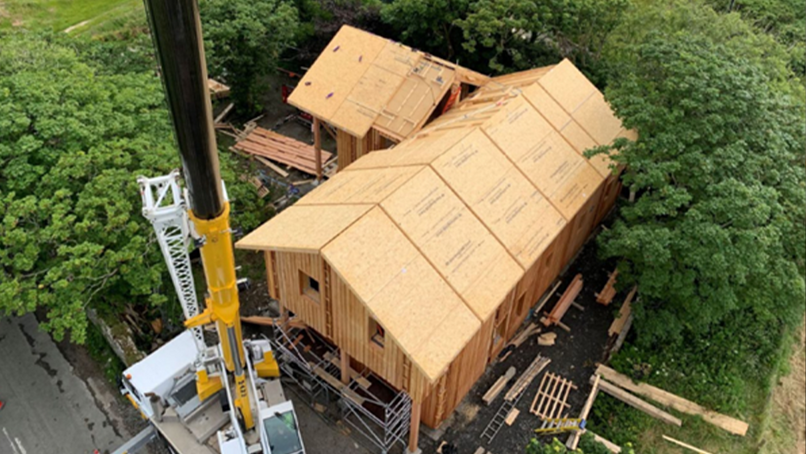
This ensures their customer network can be assured that the panel products they are using to produce, for example, structural insulated panels (SIPs) and other offsite systems like floor cassettes, as well as for sheathing, decking and other applications, all fully meet the spirit as well as the regulations which will expand the use of carbon negative building materials.