
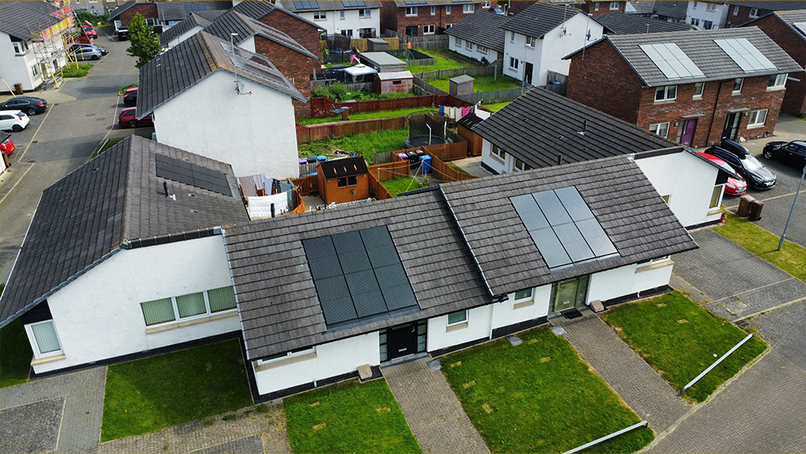
A number of industry organisations have given a cautious welcome to the government's newly published Future Homes Standard.
NFRC (National Federation of Roofing Contractors) has welcomed the confirmation that solar panels will feature on "majority of new homes in England" in the Future Homes Standard. However, it also urges ministers not to let ambition outpace the safety frameworks needed to deliver it responsibly.
NFRC says it strongly supports the expansion of rooftop solar and is eager to see it done correctly and efficiently. However, significant gaps in installer competence standards, cross-trade responsibility delineation, and fire safety testing remain unresolved, and the government's announcement accelerates deployment before those gaps have been sufficiently resolved.
Ben Rowlands, NFRC Head of Solar PV, said: "The direction of travel is right, and we want solar to succeed. But rooftop solar is a roofing system decision as much as an electrical one, and the current accreditation framework does not reflect that. Industry is still working through where responsibilities between trades begin and end, and consumers are bearing the risk in the meantime.
"The more solar we put into the built environment, the more important it becomes to get the basics right. Solar-related fires are already rising at roughly twice the rate of installations. We cannot keep scaling deployment and hope the safety framework catches up. This not only risks homeowner safety, but also the future of the industry."
NFRC calls on the government to ensure roofing expertise is represented in the workforce that will deliver the Future Homes Standard and Warm Homes Plan, and to treat rooftop solar as part of the building envelope, not a bolt-on electrical product distinct from the built environment.
Neil Hargreaves, Managing Director of Knauf Insulation, said: "Housebuilders will be pleased today. A standard to deliver more efficient and comfortable homes for their customers, but without requiring wholesale reinvention. In most cases, fabric compliance will be readily achievable using non-combustible insulation in 150mm wall cavities and more efficient lofts.
"That should buy space to address an inherent mid-term risk. With fine-tuned heat pumps replacing brute force gas boilers, any fabric performance gap will be much more keenly felt by homeowners (and seen on their electricity bills). Couple that with EPC Reform soon giving them the right to have their new home assessed, and the SMETER programme giving them the means to do so, and ‘as-built' performance quickly becomes an acute concern.
"For all housebuilders, the right Future Homes adoption strategy will include design and process choices that mitigate this risk to prevent future headaches."
Stuart Nicholson, Managing Director of Marley, commented: "Marley welcomes the publication of the Future Homes Standard, which provides a clear and ambitious pathway for the construction industry to follow. The standard comes into force on 24 March 2027, with a 12-month transition period, meaning that construction on new build homes will need to produce at least 75% fewer carbon emissions compared to current regulations from 24 March 2028. This is a significant step forward in creating a more sustainable future.
"The combination of mandatory low-carbon heating technologies such as heat pumps, high-performance insulation, improved airtightness, and the specification of solar PV panels on roofscapes will have a transformative impact. These measures will create warmer, more energy-efficient, and low-carbon homes, while also helping to reduce energy bills for homeowners.
"We are particularly encouraged by the requirement for solar PV panels to cover an area equivalent to 40% of the ground floor space, which underscores the critical role of roofing solutions in achieving energy efficiency. However, we recognise that exemptions may apply where design constraints make compliance challenging, and we support a balanced approach to ensure practical implementation across all housing types.
"Throughout the consultation process, roofing solutions have been identified as a key contributor to effective energy-efficiency improvements, with solar PV playing a particularly prominent role. Today's solar PV solutions, such as Marley's SolarTile®, can be seamlessly integrated into the building fabric, maximizing on-site renewable energy generation while maintaining strong aesthetic appeal.
"With the Future Homes Standard now dictating the direction of travel, we expect the specification of integrated solar PV solutions to become a commonplace decision as the sector responds to this new legislative landscape. Marley is committed to supporting the industry in meeting these ambitious targets and delivering sustainable, energy-efficient homes for the future."
Neil Sawers, Commercial Technical Manager at Grant UK, added: "As a manufacturer and supplier of low carbon heating technologies, we recognise the vital importance of decarbonising the UK's housing stock and support the overarching ambition of the Future Homes Standard to deliver warm homes that are "zero-carbon ready by default."
"The government's decision to position heat pumps as the baseline technology within the "notional building" specification for new dwellings represents a significant milestone for our industry. We have long maintained that heat pump technology is a highly viable, efficient and practical solution for new build properties, where high levels of insulation and airtightness allow these systems to perform at their optimum.
"We must also acknowledge the practical challenges that accompany this rapid transition. The projected scale of expansion (aiming for half of all UK homes to be heated by heat pumps by 2040) will require unprecedented collaboration across the sector. The capital cost uplifts identified in the assessment and ensuring that there is a sufficiently skilled and trained workforce to install and maintain these systems at scale remains a critical hurdle that must be overcome.
"We are committed to working closely with developers, merchants, installers and the government to navigate these challenges. By continuing to innovate and provide comprehensive training support, we believe the industry can deliver on the promise of the Future Homes Standard."